AI Development Stages: ANI → AGI → ASI #
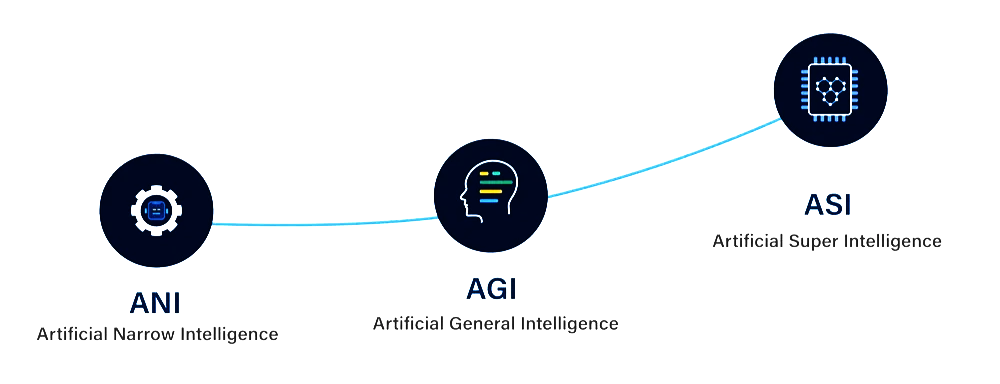
Artificial Intelligence is often described in three stages, based on capability and scope:
- ANI: Task-specific intelligence (today’s AI)
- AGI: Human-level general intelligence (future goal)
- ASI: Beyond human intelligence (theoretical)
ANI — Artificial Narrow Intelligence #
- also called Weak AI
- designed to perform one specific task
- Operates within a predefined environment
- Cannot generalise beyond its training
- Most AI systems today are ANI
examples
- Spam email filters
- Voice assistants (Siri, Alexa)
- Face recognition systems
- Recommendation engines (YouTube, Netflix, Amazon)
- Fraud detection in banking
Generative AI (GAI) #
- A subset of ANI
- Built using deep learning models
- Creates new content instead of just predictions
- Learns patterns from vast datasets
examples
- ChatGPT (text)
- DALL·E / Midjourney (images)
- Music and video generation tools
AGI — Artificial General Intelligence #
- also called Strong AI
- Human-level intelligence across many domains
- can learn, reason, and adapt to new tasks without retraining
- can transfer knowledge from one domain to another
- does not currently exist in reality
- current AI That Hints at AGI (but isn’t): GPT-4/LLMs, DeepMind’s Gato, Self-Driving Cars/AlphaGo
examples
- An AI that can learn medicine, law, and engineering like a human
- A robot that can reason, plan, learn new skills, and adapt to new environments
- A system that understands context, emotions, and abstract concepts
ASI — Artificial Superintelligence #
- represents a hypothetical future
- Intelligence that surpasses human intelligence in most or all domains
- capable of rapid self-improvement
- extremely high impact on science, society, and humanity
- raises serious ethical, safety, and control concerns