AI Foundation
 January 26, 2026
AI #
A selection of notes that didn’t fit elsewhere or are being worked on!.
Home
January 26, 2026A selection of notes that didn’t fit elsewhere or are being worked on!.
March 12, 2026This page is a quick reference of definitions + formulas, grouped by the modules.
Sample mean (ungrouped):
January 3, 2026Trained using labelled data.
Each example in the training set includes the correct output.
The algorithm learns to generalise and make predictions on unseen data.
Generally more accurate than unsupervised methods.
Requires human intervention for labelling and setup.
Widely used due to its accuracy and efficiency.
Produces highly accurate results when trained on good-quality labelled data.
Output is discrete (e.g. Yes/No, Spam/Not Spam).
Used for categorising data into predefined classes.
Support Vector Machine (SVM) is a common classifier (a linear classifier with margin-based separation).
July 4, 2024Learning how machines learn! My working notes as I learn AI.
flowchart LR
    AI[Artificial Intelligence]
    ML[Machine Learning]
    DL[Deep Learning]
    FM[Foundation Models]
    LLM[LLM Models]

    AI --> ML
    ML --> DL
    DL --> FM
    FM --> LLM

    style AI fill:#E1F5FE
    style ML fill:#C8E6C9
    style DL fill:#90CAF9
    style FM fill:#64B5F6
    style LLM fill:#FFCCBC
flowchart TD
AI["Artificial<br/>Intelligence"]
ML["Machine<br/>Learning"]
NN["Neural<br/>Networks"]
DL["Deep<br/>Learning"]
FM["Foundation<br/>Models"]
LLM["LLM<br/>Models"]

AI --> ML
ML --> NN
NN --> DL
DL --> FM
FM --> LLM

LR["Linear<br/>Regression"]
DT["Decision<br/>Trees"]
ML --> LR
ML --> DT

MLP["MLP"]
CNN["CNN"]
NN --> MLP
NN --> CNN

CNNDL["CNN<br/>(deep)"]
RNN["RNN"]
DL --> CNNDL
DL --> RNN

BERT["BERT"]
CLIP["CLIP"]
FM --> BERT
FM --> CLIP

GPT["GPT"]
LLAMA["LLaMA"]
LLM --> GPT
LLM --> LLAMA

TEXT["Text"]
IMAGE["Images"]
AUDIO["Audio"]
VIDEO["Video"]
LLM --> TEXT
LLM --> IMAGE
LLM --> AUDIO
LLM --> VIDEO

style AI fill:#90CAF9,stroke:#1E88E5,color:#000
style ML fill:#90CAF9,stroke:#1E88E5,color:#000
style NN fill:#90CAF9,stroke:#1E88E5,color:#000

style DL fill:#CE93D8,stroke:#8E24AA,color:#000
style FM fill:#CE93D8,stroke:#8E24AA,color:#000

style LLM fill:#C8E6C9,stroke:#2E7D32,color:#000
style LR fill:#C8E6C9,stroke:#2E7D32,color:#000
style DT fill:#C8E6C9,stroke:#2E7D32,color:#000
style MLP fill:#C8E6C9,stroke:#2E7D32,color:#000
style CNN fill:#C8E6C9,stroke:#2E7D32,color:#000
style CNNDL fill:#C8E6C9,stroke:#2E7D32,color:#000
style RNN fill:#C8E6C9,stroke:#2E7D32,color:#000
style BERT fill:#C8E6C9,stroke:#2E7D32,color:#000
style CLIP fill:#C8E6C9,stroke:#2E7D32,color:#000
style GPT fill:#C8E6C9,stroke:#2E7D32,color:#000
style LLAMA fill:#C8E6C9,stroke:#2E7D32,color:#000
style TEXT fill:#C8E6C9,stroke:#2E7D32,color:#000
style IMAGE fill:#C8E6C9,stroke:#2E7D32,color:#000
style AUDIO fill:#C8E6C9,stroke:#2E7D32,color:#000
style VIDEO fill:#C8E6C9,stroke:#2E7D32,color:#000
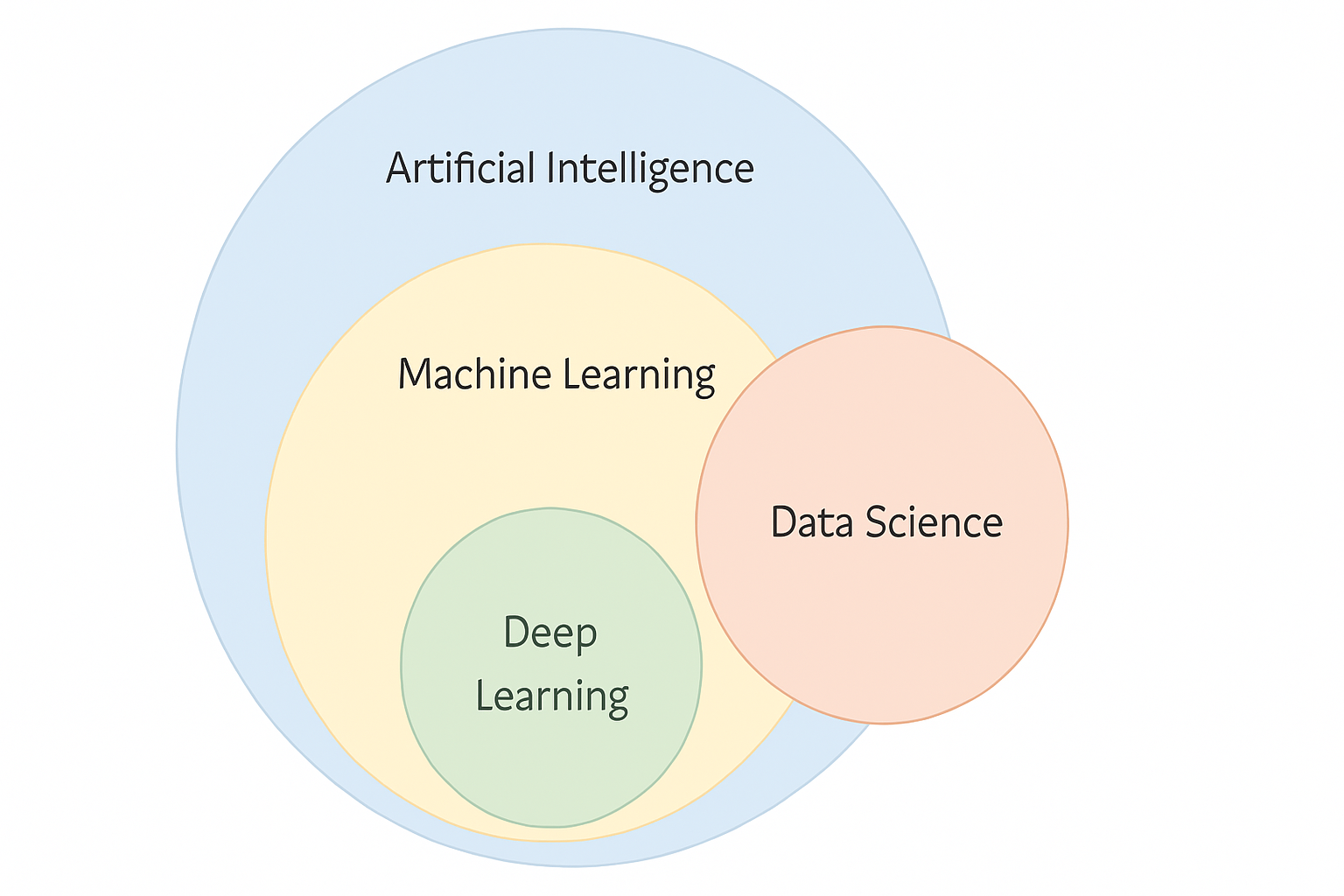
February 25, 2026Keep this page as a quick reference of definitions + formulas.
Sample mean (ungrouped):
January 3, 2026
August 6, 2024
stateDiagram-v2

    %% ===== CLASS DEFINITIONS (Math-based colours) =====
    classDef algebra fill:#cfe8ff,stroke:#1e3a8a,stroke-width:1px
    classDef probability fill:#d1fae5,stroke:#065f46,stroke-width:1px
    classDef geometry fill:#ffedd5,stroke:#9a3412,stroke-width:1px
    classDef logic fill:#ede9fe,stroke:#5b21b6,stroke-width:1px
    classDef category font-style:italic,font-weight:bold,fill:#aaaaaa,stroke:#374151,stroke-width:3px

    %% ===== ROOT =====
    ML: Machine Learning

    %% ===== SUPERVISED =====
    ML --> SL:::category
    SL: Supervised Learning

    SL --> Regression
    Regression --> LR:::algebra
    LR: Linear Regression

    LR --> NN:::algebra
    NN: Neural Network

    NN --> DT:::logic
    DT: Decision Tree

    SL --> Classification
    Classification --> NB:::probability
    NB: Naive Bayes

    NB --> KNN:::geometry
    KNN: k-Nearest Neighbours

    KNN --> SVM:::algebra
    SVM: Support Vector Machine

    %% ===== UNSUPERVISED =====
    ML --> USL:::category
    USL: Unsupervised Learning

    USL --> Clustering
    Clustering --> KM:::geometry
    KM: K-Means

    KM --> GMM:::probability
    GMM: Gaussian Mixture Model

    GMM --> HMM:::probability
    HMM: Hidden Markov Model

    %% ===== REINFORCEMENT =====
    ML --> RL:::category
    RL: Reinforcement Learning

    RL --> DM:::logic
    DM: Decision Making
Used heavily when models rely on:
December 15, 2025Generative Artificial Intelligence (GenAI) refers to a class of AI systems that can generate new content such as text, images, audio, video, or code, rather than only making predictions or classifications.
GenAI systems learn patterns and representations from large datasets and use them to produce novel outputs that resemble the data they were trained on.
| Traditional AI | Generative AI |
|---|---|
| Predicts or classifies | Generates new content |
| Task-specific models | General-purpose models |
| Fixed outputs | Open-ended outputs |
| Often rule-based | Data-driven and probabilistic |
Instead of learning “what label to assign”, Generative AI learns “how data is structured” and then creates new data following that structure.
April 22, 2026| Step | Perceptron (Boolean/Logic) | Linear Regression Network | Binary Classification (Logistic) | DFNN / MLP (Classification) |
|---|---|---|---|---|
| 1. Input | Take binary or discrete inputs \( x_1, \dots, x_n \) | Take numerical features \( x \) | Take numerical features \( x \) | Take high-dimensional numerical or categorical features |
| 2. Weighted Sum | Single calculation: \( z = \sum (w_i x_i) + b \) | Single calculation: \( \hat{y} = w_0 + w_1 x \) | Single calculation: \( z = W x + b \) | Multiple stages: \( z^{[l]} = W^{[l]} a^{[l-1]} + b^{[l]} \) for each layer \( l \) |
| 3. Activation | Step Function: Output 1 if \( z \geq 0 \) , else 0 | Identity: The output remains \( z \) (no non-linear change) | Sigmoid: Maps \( z \) to a probability between 0 and 1 | ReLU for hidden layers; Softmax/Sigmoid for the output layer |
| 4. Loss / Error | Error = Target − Output | Mean Squared Error (MSE): \( J = \frac{1}{2N} \sum (Y - \hat{y})^2 \) | Binary Cross-Entropy (BCE): penalises based on probability distance | BCE or Categorical Cross-Entropy for multiple classes |
| 5. Optimisation | Update weights only on misclassification | Gradient Descent: compute gradients at initialization and update weights | Backpropagation: compute error signals \( \delta \) and gradients \( dW \) | Backpropagation: recursive chain rule to update all hidden layer weights |
| 6. Output | Discrete Boolean value (0 or 1) | Continuous numerical value (e.g., house prices) | Single probability score or class label | A vector of probabilities for multiple classes |
flowchart LR
    %% Input Layer
    subgraph subGraph0["Input Layer"]
        I1(("Input 1"))
        I2(("Input 2"))
        I3(("Input 3"))
    end

    %% Hidden Layers
    subgraph subGraph1["Hidden Layer 1"]
        H1a(("H1-1"))
        H1b(("H1-2"))
        H1c(("H1-3"))
    end

    subgraph subGraph2["Hidden Layer 2"]
        H2a(("H2-1"))
        H2b(("H2-2"))
        H2c(("H2-3"))
    end

    subgraph subGraph3["Hidden Layer 3"]
        H3a(("H3-1"))
        H3b(("H3-2"))
        H3c(("H3-3"))
    end

    %% Output Layer
    subgraph subGraph4["Output Layer"]
        O(("Output"))
    end

    %% Connections: Input to Hidden Layer 1
    I1 --> H1a & H1b & H1c
    I2 --> H1a & H1b & H1c
    I3 --> H1a & H1b & H1c

    %% Connections: Hidden Layer 1 to Hidden Layer 2
    H1a --> H2a & H2b & H2c
    H1b --> H2a & H2b & H2c
    H1c --> H2a & H2b & H2c

    %% Connections: Hidden Layer 2 to Hidden Layer 3
    H2a --> H3a & H3b & H3c
    H2b --> H3a & H3b & H3c
    H2c --> H3a & H3b & H3c

    %% Connections: Hidden Layer 3 to Output
    H3a --> O
    H3b --> O
    H3c --> O

    %% Styling
    style I1 fill:#C8E6C9
    style I2 fill:#C8E6C9
    style I3 fill:#C8E6C9
    style H1a fill:#BBDEFB
    style H1b fill:#BBDEFB
    style H1c fill:#BBDEFB
    style H2a fill:#90CAF9
    style H2b fill:#90CAF9
    style H2c fill:#90CAF9
    style H3a fill:#64B5F6
    style H3b fill:#64B5F6
    style H3c fill:#64B5F6
    style O fill:#FFCDD2
    style subGraph0 stroke:none,fill:transparent
    style subGraph1 stroke:none,fill:transparent
    style subGraph2 stroke:none,fill:transparent
    style subGraph3 stroke:none,fill:transparent
    style subGraph4 stroke:none,fill:transparent
| Step | Perceptron (Boolean/Logic) | Linear Regression Network | Binary Classification (Logistic) | DFNN / MLP (Classification) |
|---|---|---|---|---|
| 1. Input | Binary/discrete inputs \( x_1, \dots, x_n \) | Numerical features \( x \) | Numerical features \( x \) | High-dimensional numerical or categorical features |
| 2. Weighted Sum | \( z = \sum (w_i x_i) + b \) | \( \hat{y} = w_0 + w_1 x \) | \( z = W x + b \) | \( z^{[l]} = W^{[l]} a^{[l-1]} + b^{[l]} \) |
| 3. Activation | Step: 1 if \( z \geq 0 \) , else 0 | Identity: output = \( z \) | Sigmoid: maps \( z \) to probability | ReLU (hidden), Softmax/Sigmoid (output) |
| 4. Loss / Error | Error = Target − Output | \( J = \frac{1}{2N} \sum (Y - \hat{y})^2 \) | Binary Cross-Entropy (BCE) | BCE or Categorical Cross-Entropy |
| 5. Optimisation | Update on misclassification | Gradient Descent | Backpropagation (single layer) | Backpropagation (multi-layer chain rule) |
| 6. Output | Boolean (0 or 1) | Continuous value | Probability score | Probability vector (multi-class) |
Deep Learning is the methodology, DNN is a model.
RL is learning by trial and error.
Reinforcement Learning (RL) is a type of machine learning where an autonomous agent learns to make decisions by interacting with an environment.
Instead of being told the correct answer, the agent:
Reinforcement Learning teaches an agent how to act, not what to predict.