ASI

AI Stages: ANI, AGI, ASI

AI Development Stages: ANI → AGI → ASI #

Artificial Intelligence is often described in three stages, based on capability and scope:

  • ANI: Task-specific intelligence (today’s AI)
  • AGI: Human-level general intelligence (future goal)
  • ASI: Beyond human intelligence (theoretical)
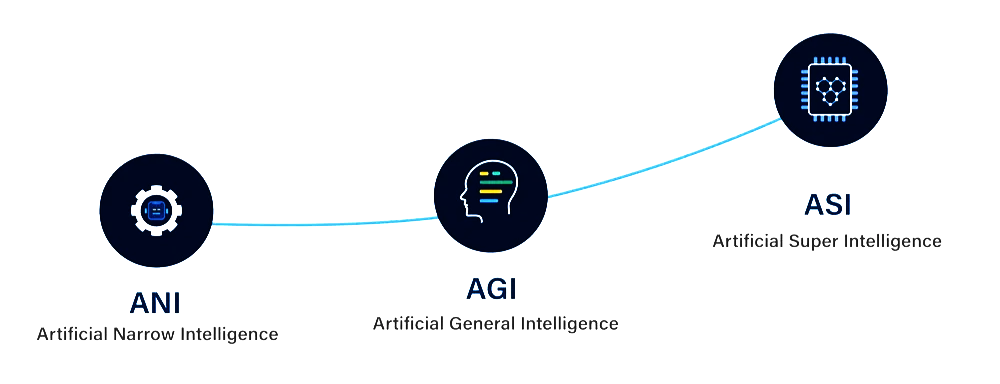
AI Stages


ANI — Artificial Narrow Intelligence #

  • also called Weak AI
  • designed to perform one specific task
  • Operates within a predefined environment
  • Cannot generalise beyond its training
  • Most AI systems today are ANI

examples

AI Agents

AI Agents #

Also referred to as Agentic AI.

AI agents are intelligent systems that can plan, make decisions, and take actions to achieve goals with minimal human intervention.

  • A common use case is task automation

  • for example booking travel based on a user’s request.

  • AI agents typically build on Generative AI and use Large Language Models (LLMs) as the reasoning core.

  • Agents often interact with tools (APIs, databases, calendars) to complete multi-step workflows.

Transformer

Transformer #

  • is an architecture of neural networks

  • based on the multi-head attention mechanism

  • text is converted to numerical representations called tokens, and each token is converted into a vector via lookup from a word embedding table

  • takes a text sequence as input and produces another text sequence as output

  • foundation for modern Large Language Models (LLMs) like ChatGPT and Gemini

  • Transformer architecture

  • Model, Positionwise Feed-Forward Networks, Residual Connection and Layer Normalization