Mathematics
Linear Algebra
 May 28, 2026
Linear Algebra #
The study of vectors and matrices is called Linear Algebra.
Linear Algebra provides the mathematical language used to represent data, transformations, and structure in ML.
Why Linear Algebra Matters in ML #
- Every machine learning model uses matrices
- All data in ML is represented using vectors and matrices
- Neural networks are pipelines of matrix operations
- Models apply matrix transformations to data
- Optimisation relies on linear algebra operations
What to Learn #
- Scalars, vectors, and matrices
- Vector operations (addition, dot product)
- Matrix multiplication (critical)
- Identity matrices and transpose
- Eigenvalues and eigenvectors (conceptual understanding)
- Scalar → a number
- Vector → a directed point
- Matrix → a space transformer
- Linear transformation → structured mapping
- Feature → one axis
- Feature space → where data lives
- Vector space → where vectors live
Linear Systems
January 29, 2026Linear Systems #
How systems of linear equations are represented and solved using matrices.
- the study of vectors and rules to manipulate vectors
- describe multiple linear equations solved simultaneously
- connect algebraic equations with matrix representations
Idea of Closure #
performing a specific operation (like addition or multiplication) on members of a set always produces a result that belongs to the same set
idea of closure is fundamental to defining a Vector space because it ensures that performing arithmetic operations (addition and scalar multiplication) on vectors within a set does not produce a new element outside that set.
Systems of Linear Equations
Systems of Linear Equations #
A system of linear equations can be written compactly as:
\[ A\mathbf{x}=\mathbf{b} \]
This represents:
- a linear transformation applied to an unknown vector (\mathbf{x})
- producing an output vector (\mathbf{b})
Key components #
Coefficient matrix (A) #
(A) contains the coefficients of the variables.
Calculus
Calculus #
Calculus is:
- the mathematical framework for understanding and controlling how quantities change
- the mathematics of change and accumulation
It helps answer:
- How fast is something changing right now?
- What happens when inputs change slightly?
- Where is something maximum or minimum?
It answers two big questions:
- How fast is something changing right now? → derivatives (differentiation)
- How much has accumulated over an interval? → integrals (integration)
flowchart TD
  A[Calculus] --> B[Limits]
  B --> C[Continuity]
  B --> D[Derivatives]
  B --> E[Integrals]
  D --> F[Optimisation: maxima/minima]
  D --> G[ML: gradients & learning]
  E --> H[Accumulation: area/total change]
Differential Calculus (Rates of Change) #
Studies how things change.
Matrices
Matrices #
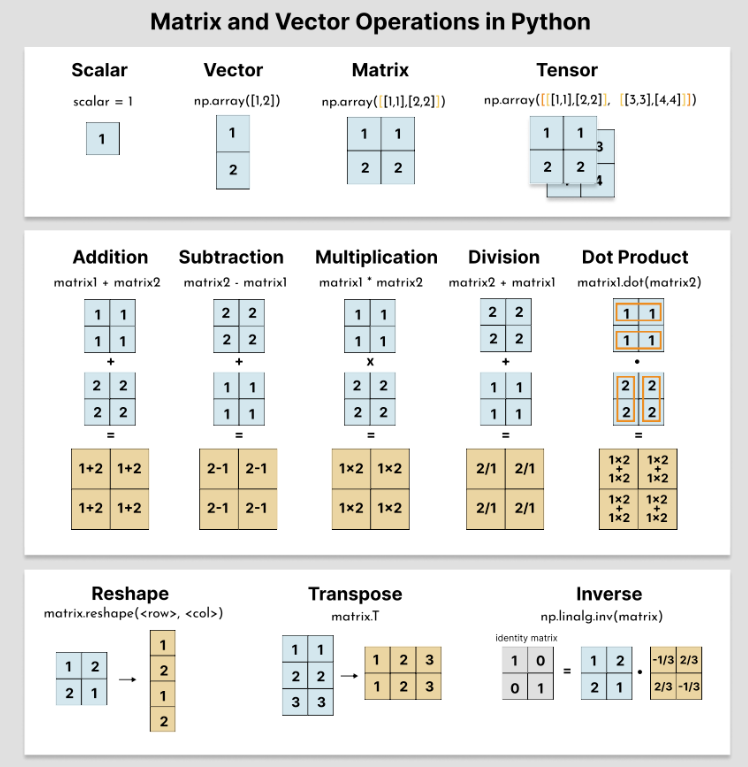
Matrices are the core data structure of linear algebra and the workhorse of machine learning.
Almost every ML model can be described as a sequence of matrix operations.Matrix #
A matrix is a rectangular array of numbers arranged in rows and columns.
\[ A \in \mathbb{R}^{m \times n} \]
An ( m \times n ) matrix has:
Solving Linear Systems
Solving Linear Systems #
Solve using:
- Substitution Method
- Elimination Method (Multiple & then Subtract)
- Cross Multiplication
Linear system can have:
- no solution
- a unique solution
- infinitely many solutions
Positive Definite Matrices #
A square matrix is positive definite if pre-multiplying and post-multiplying it by the same vector always gives a positive number as a result, independently of how we choose the vector.
Positive definite symmetric matrices have the property that all their eigenvalues are positive.
Forward and Backward Substitution
Forward and Backward Substitution #
Forward and backward substitution are efficient algorithms used to solve linear systems when the coefficient matrix is triangular.
They are typically used after:
- Gaussian elimination
- LU decomposition
1. Forward Substitution (Lower Triangular Systems) #
Used to solve:
\[ L\mathbf{x} = \mathbf{b} \]
where (L) is a lower triangular matrix:
Inverse Matrix
Inverse Matrix #
The inverse of a matrix is a matrix that, when multiplied with the original matrix, produces the identity matrix.
A square matrix (A) is invertible if there exists a matrix (A^{-1}) such that:
\[ AA^{-1} = A^{-1}A = I \]
Here:
Convex Combination
January 29, 2026Convex Combination of Two Points #
A convex combination describes how to form a point between two points using weighted averages.
It is a fundamental building block in several advanced fields:
- Linear Algebra & Geometry
- Optimization Theory
- Machine Learning (Specifically in SVMs, clustering, and data interpolation)
Given two points (or vectors) $\mathbf{x}_1, \mathbf{x}_2 \in \mathbb{R}^n$, a convex combination of these points is defined as:
$$\mathbf{x} = \lambda \mathbf{x}_1 + (1 - \lambda)\mathbf{x}_2$$Where: